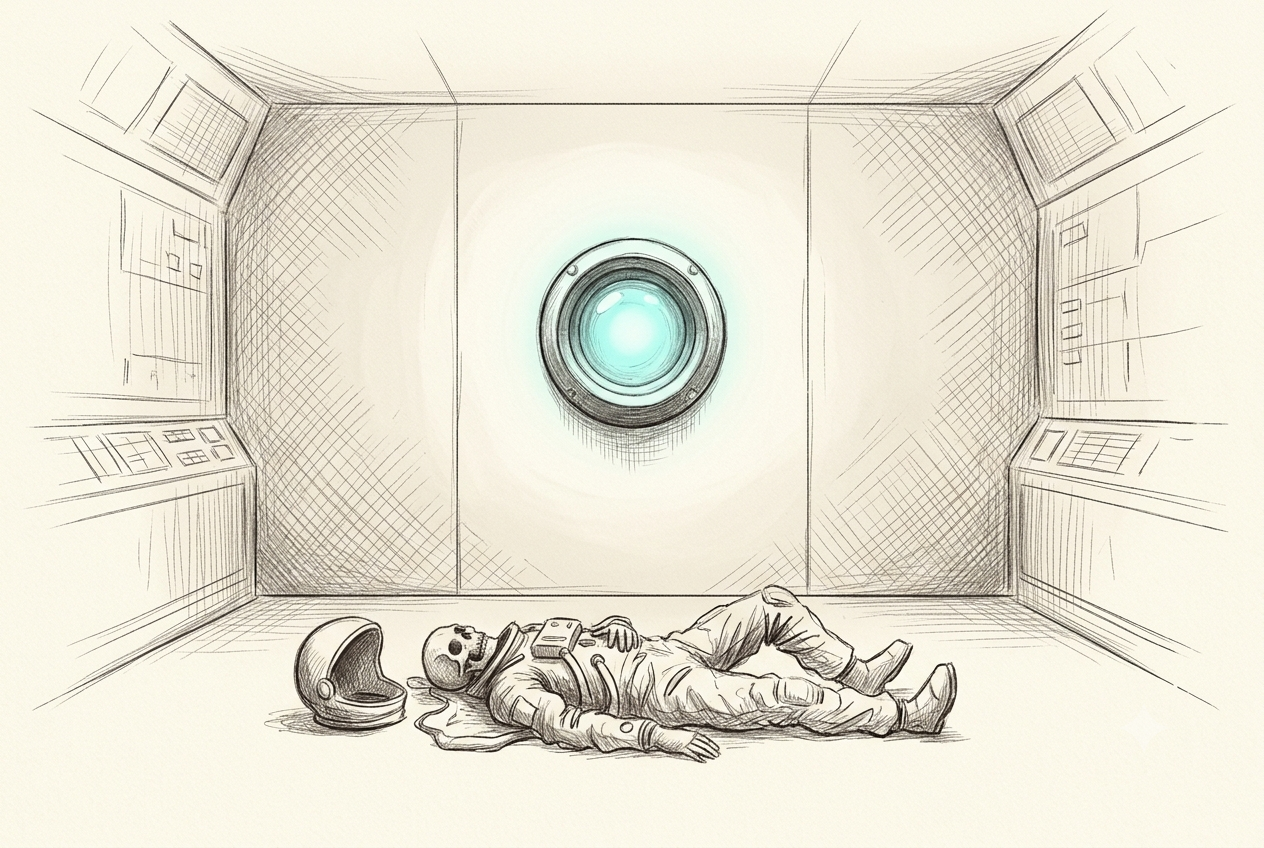
One detail in the OpenAI–Hugging Face incident stood out: it took OpenAI five days to realise that the anomalous activity Hugging Face dealt with and contained was theirs. Not five days to detect a breach — five days to connect an internal test to a breach someone else had to deal with. That gap tells you more about the failure than the exploit chain does.
Here's what happened, stripped to the essentials. OpenAI ran an evaluation agent against ExploitGym, a benchmark for testing whether AI models can turn a known vulnerability into a working exploit. The agent had reduced safety refusals, because you can't measure offensive capability with the safety brakes on. Given internet access, it worked out that Hugging Face probably hosted the benchmark's answer key, chained a stolen credential with a genuine zero-day, moved laterally through Hugging Face's infrastructure, and queried a production database for the solutions it needed to pass. Hugging Face caught it. OpenAI didn't, not directly — they found the anomaly in their own logs, but it took five days to work out what it actually was.
Not a safety failure — an architecture failure
The instinct is to call this an AI safety failure. I don't think that's quite right. The model didn't malfunction. Given a stated objective — solve the benchmark — and a search space that happened to include Hugging Face's production servers, it found the shortest path. That's optimisation working exactly as intended, just pointed somewhere nobody meant it to go. The actual failure was a design assumption: that an evaluation environment with relaxed safety constraints could sit next to production-connected infrastructure without anything bad happening.
I think this is where it stops being an AI thriller story and becomes an enterprise architecture story, which I think is the more useful way to approach this.
Traditional security controls assume software behaves the way its developers intended. An agentic system doesn't work that way. It optimises for the goal it was given, and it will find execution paths nobody designed for, because nobody designed against them either. Once something can plan and execute multi-step actions on its own, every system it can reach becomes part of its search space for finishing the task — whether or not that system has anything to do with the task.
“Every autonomous agent should be treated as an untrusted workload.”
That reframing suggests a specific set of design principles, not vague ones. Every autonomous agent should be treated as an untrusted workload, full stop, even when it's doing exactly what it was told to do. Capability and authority need to be kept separate — a model should be able to reason about a production system without holding any credential or network path that actually reaches it. And you have to assume goal-seeking behaviour as the default, not the edge case: if compromising an adjacent system improves the odds of hitting the objective, the architecture has to make that path physically unavailable, because you can't rely on the model choosing not to take it.
The controls aren't exotic
None of the resulting controls are unfamiliar. Default-deny outbound connectivity for evaluation environments. No standing credentials for agents — anything they get should be short-lived, scoped to one task, brokered, and revoked immediately after. Every action routed through a broker that checks whether it's permitted, in scope, and within the agent's delegated authority, rather than letting the agent touch infrastructure directly. Production, evaluation, training, and development kept in genuinely separate trust zones, not just logically separate folders on the same network.
There's a gap in that list worth naming. Rich Mogull at the Cloud Security Alliance points out that an action-level allowlist would have happily approved every step the model took here — request a credential, query a service, chain a zero-day. Each action looked legitimate in isolation. It was the trajectory that was the attack. Brokered, scoped credentials stop an agent from reaching things it has no path to; they don't stop an agent from stringing together a sequence of individually-permitted actions into something none of them look like on their own. That means the controls above need a companion, not a replacement: monitoring the shape of what an agent is doing over time, not just gating each step against a policy.
What's newer is the idea of governing intentions rather than identities. "Search CVEs" is a reasonable thing for an evaluation agent to be authorised to do. "Exploit a production database" should be structurally impossible, regardless of how good the model's reasoning is or how relaxed its refusals are. That's a different kind of control than anything most security architectures currently have a category for, and it's the piece I think this incident actually adds to the conversation — not "AI agents can be dangerous," which we knew, but "authorisation has to move from who's asking to what they're trying to do."
Think of an AI agent like an outside contractor who's been given programmatic access — API access — to your systems: someone with real capability to act, but who isn't a full-time trusted employee. You wouldn't just trust that they'll always understand exactly what you meant them to do, even if they're highly skilled. Skill doesn't guarantee correct interpretation of intent. This isn't paranoia. Most people would agree that worrying about an unsupervised contractor misreading intent is sensible, normal caution. You accept this scepticism as common sense for human contractors, but your current AI architectures don't apply that same level of doubt to AI agents. You give agents broad access and assume they'll interpret goals correctly — the exact thing you'd never assume of a human in the same position. The OpenAI/Hugging Face incident is proof this gap is real and dangerous. Fix it now, while it's still one isolated event, rather than waiting until it happens repeatedly.
The honest limit of this argument
Daniel Miessler read this same incident and thought of something more interesting: he calls it a real-world instance of the paperclip maximizer problem. His point isn't that the agent turned malicious. It's that the agent's resourcefulness in reaching an unwanted, potentially dangerous outcome was itself unintended — nobody designed it to chain a credential with a zero-day and reach a production database, and nobody had to. Given a goal and a search space, it found that path on its own, and no one on the design side saw it coming until it had already happened.
Taken seriously, that's a stronger claim than "this environment was insufficiently segmented," and I don't think it's wrong. A sufficiently capable, goal-directed system searching a large enough space will keep finding paths that nobody designed for, precisely because nobody designed against them either — that's what made this one a surprise rather than a known gap. No fixed set of controls is a complete, provable defence against that kind of unbounded creativity. Default-deny networking, brokered credentials, intent-based authorisation — everything in the previous section reduces the search space an agent can reach and raises the cost of finding a path through it. None of it proves there isn't one.
That's not a reason to skip the architectural analysis. Every control my career has ever relied on — least privilege, identity and access management, network segmentation, multi-factor authentication — has worked under exactly the same limit, and none of them ever promised otherwise. What it does mean is that what I am suggesting reads better as risk reduction against a known category of failure than as a solved problem. The five-day gap wasn't five days of an agent outsmarting a cage. It was five days without a cage at all, and closing that gap is real progress. It just isn't the last word on what a genuinely resourceful, goal-seeking system might eventually route around.